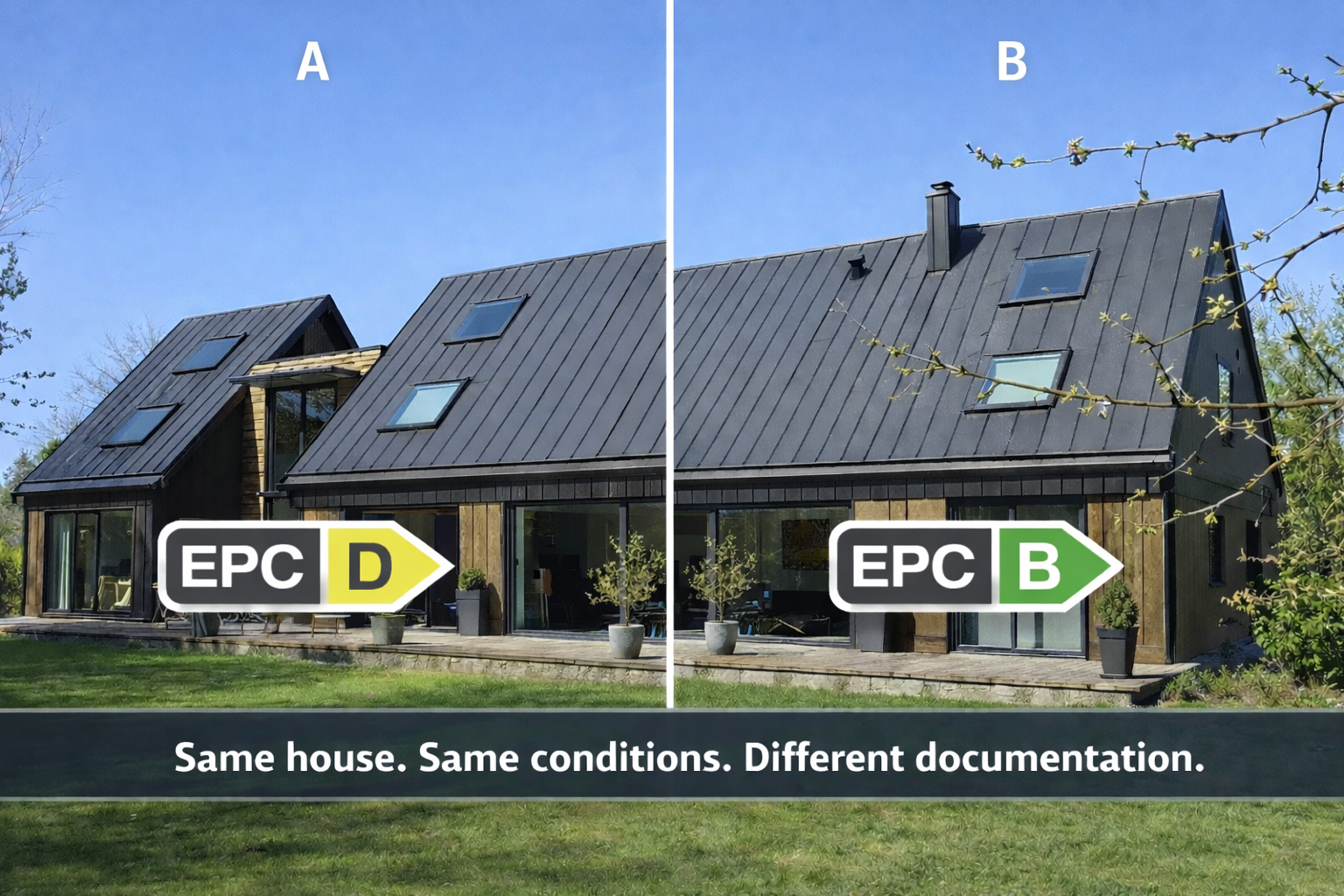
Same building. Same reality.
Why two different EPC labels?
Introduction
- Two single-family houses built in 1984.
- Recently renovated.
- Same apparent insulation level.
- Same technical systems.
👉 Yet two different EPC scores:
🏠 House A: EPC D
🏠 House B: EPC B
How can such a gap be explained when, on site, the buildings appear identical?
On site?
There is no visible difference:
- Not in the walls
- Not in the windows
- Not in the roof
- Not in the technical installations
👉 The difference is not visible — it is documentary.
It depends exclusively on the evidence available at the time the EPC certificate is issued.
The fundamental principle of EPC certification
In all EPC in Wallonia (and more broadly in Belgium):
👉 What is not proven is considered absent or unfavourable.
The EPC software does not interpret, assume, or optimise “by common sense”.
As soon as an element cannot be demonstrated, penalising default values are applied.
In practice:
🛑 Penalised elements without evidence
- Insulation present but undocumented → partial or no credit
- Airtightness not measured → unfavourable default value
- Technical systems without documentation → conservative assumptions
✅ Elements correctly credited when evidence is available
- Renovation invoices
- Manufacturer technical datasheets
- Usable construction-site photographs
- Airtightness (blower door) test report
- Documents consistent with the actual building condition
👉 These elements allow the assessor to accurately reflect the real energy performance of the building.
Two similar houses, two different results
- 👉 Two similar houses
- 👉 Two very different EPC outcomes
- 👉 One single real difference: documentation
An EPC certificate can be:
- produced quickly, at low cost, with limited information, or
- built rigorously, in collaboration with the property owner
At INGEBAT
We do not simply produce a mandatory administrative document.
We support our clients in creating real energy value, especially in the context of sale or rental.
We help to:
- Understand what truly influences your EPC result
- Identify missing but accessible evidence
- Decide, with full awareness, whether acting before certification makes sense
👉 A building can therefore perform well in reality, while appearing mediocre on paper.
Why acting before certification often makes sense
One key point is often underestimated:
👉 A limited investment before certification can generate significant EPC added value.
In many cases, a few targeted actions are sufficient:
- airtightness testing
- preliminary technical analysis
- reconstruction of acceptable evidence
- targeted non-destructive investigations
👉 These actions allow existing performance to be credited, without heavy renovation works.
Very often, the EPC improvement largely outweighs the cost of these preparatory actions — especially in the context of sale or rental.
Conclusion
An energy performance certificate (EPC) is not just a formality.
It is a strategic tool, provided it is prepared intelligently.
👉 At INGEBAT, we turn an obligation into an opportunity.
www.ingebat.be/peb